
AASC Newsletter – March 2026

Vol. 2026, Issue 3
March 20, 2026

Nominate Someone for the AASC New Scientist Award!

Nominations are now open for the AASC New Scientist Award in Applied Climatology to be awarded to a recent recipient of the Master’s or Ph.D. degree in North America or the U.S. Territories whose research is considered significant to applied climatology.  A full description of the award, application instructions, and selection evaluation criteria is available at https://stateclimate.org/award-program/ . 

The submission deadline is March 27, 2026.

To be eligible, the nominee must have received either an MS or PhD degree within the past five years and have a published or galley-proofed manuscript focused on some aspect of applied climatology.  Please see the award webpage for more details.

Exec Corner

Russ Schumacher


Dear AASC Members,


I’m invading your inboxes this month while Jeff is traveling internationally. Since the last newsletter, there has been a whole lot of extreme weather: a record-setting blizzard on the east coast, massive hail in Illinois, huge rains in Hawaii, severe thunderstorms in many states, fast-growing wildfires in the Great Plains, and I’m sure I’m forgetting some others. As I write this, we’re sitting under a March heat wave that is smashing records throughout the western US, which comes after the warmest winter on record in much of the west.


Out of curiosity, about a month ago I set up a simple Google alert for the phrase “state climatologist”, which I thought might be a good way to see what kinds of things state climate offices are getting quoted in the media about. I have been really impressed by the results. In the last month, there have been over 250 entries, highlighting the great work that AASC members (state climatologists, as well as assistant SCs and other climate services providers) are doing to put extreme weather into context for their communities, and elevating our profession across the country. I plan to take a deeper dive into this data in the future, but just from browsing the alerts, a large proportion of SCOs are highlighted, across a wide range of topics. Surely this method isn’t capturing everything, and talking to the media is only a small part of what we do in our AASC community. But I think the fact that we are regularly being sought out for expertise and insight is something to be very proud of. Since the extremes don’t look like they will be slowing down anytime soon: keep up the good work!


– Russ Schumacher
Colorado State Climatologist
AASC President-Elect
The Fall and Rise from the Ashes of Ashland

Shortly before noon on February 17, 2026, a fire broke out in Beaver County, Oklahoma, and rapidly grew as southwest winds gusted over 60 mph. By the early afternoon hours, dark smoke filled the skies around the Ashland, Kansas, area as the fire quickly advanced northeast toward the Kansas border. Flames from the fire became visible shortly before 4:30 p.m. on the Kansas Mesonet tower camera 8 miles south of Ashland. Subsequent images showed the rapidly moving wildfire approaching the site. At 4:35 p.m., the last image was captured showing a line of fire just yards away from the site, with the site going offline at 4:36 p.m.

Winds at the Ashland site leading up to the fire were gusting over 50 mph at 10 meters and around 40 mph at 2 meters. Relative humidity was quite dry with values as low as 9 percent. The air temperature was unseasonably warm that afternoon, ranging from the upper 70s to low 80s. As the smoke became thicker, solar radiation values dropped considerably into the 100-300 W/m² range and eventually to zero at 4:30 p.m.

The Ashland Mesonet site’s land owner lives close by, so there was great concern about the safety of him and his family along with his livestock. Two days after the fire, we heard back from the cooperator that he and his family were safe, but had lost just under 200 cattle, his barns, and his son’s house next door. We were given permission to visit the site and the area the following day, three days after the fire.

Driving through Clark County features rolling hills, grassland, dryland farms, and ranching. The Asland Mesonet site was always surrounded by knee high grass with cattle grazing nearby. The landscape across the southern part of the county looked unrecognizable with no grass and vegetation. As the cooperator said when he first sent photos of the area, “Ever been to Mars?”. As far as the eye could see there was barren land with a sense of unease knowing a catastrophic event had just occurred in this region that impacted many lives.

Driving down the access road to reach the cooperator’s farm typically means running into cattle where they will reluctantly move, with the calves quickly running to their mothers, but the cattle that did survive looked exhausted and scared with no energy to move. After meeting with the cooperator and the folks helping with his cattle, cleanup and damage assessors, the site was reached, but with no grass to drive through, just bare soil.

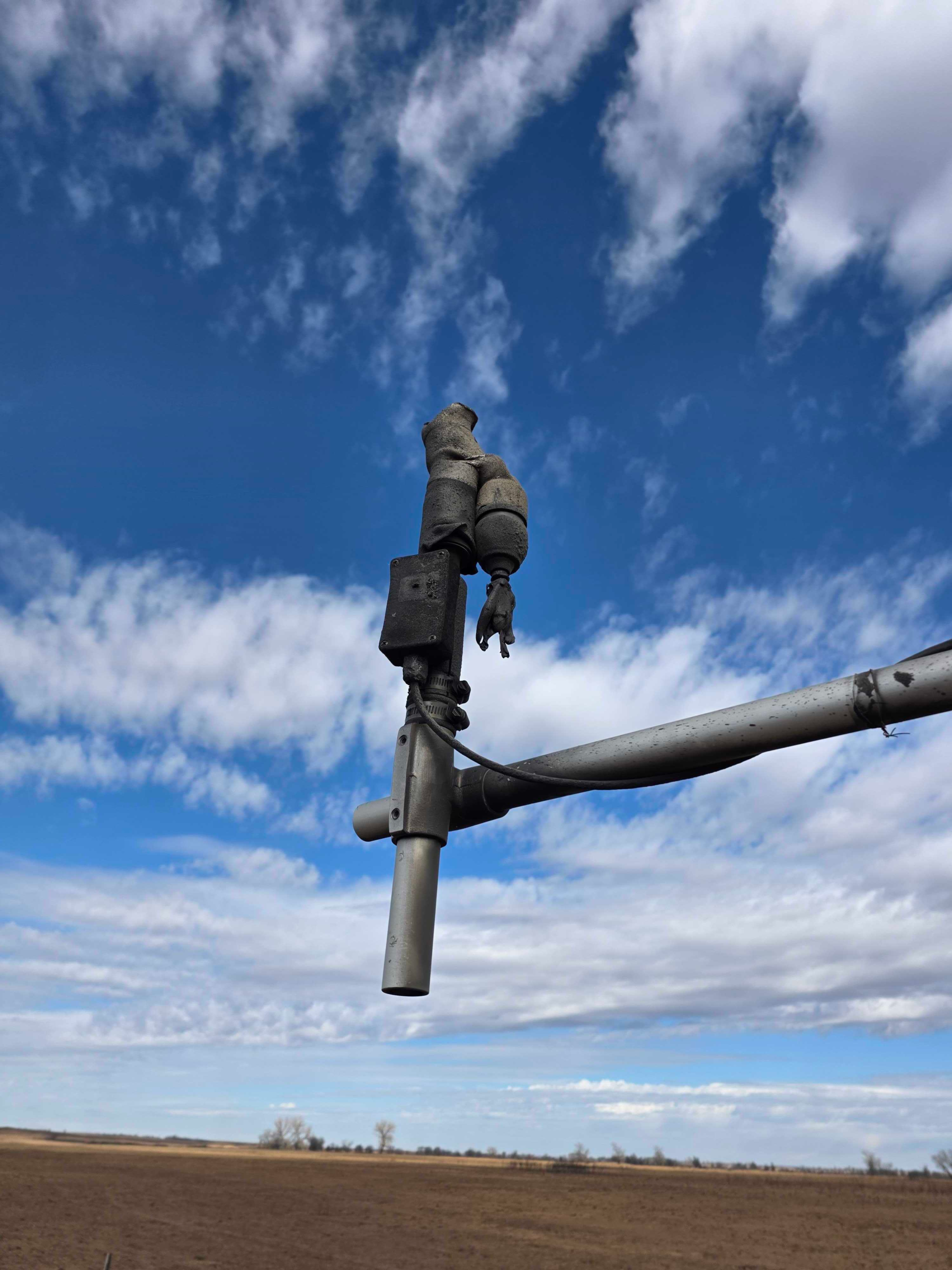
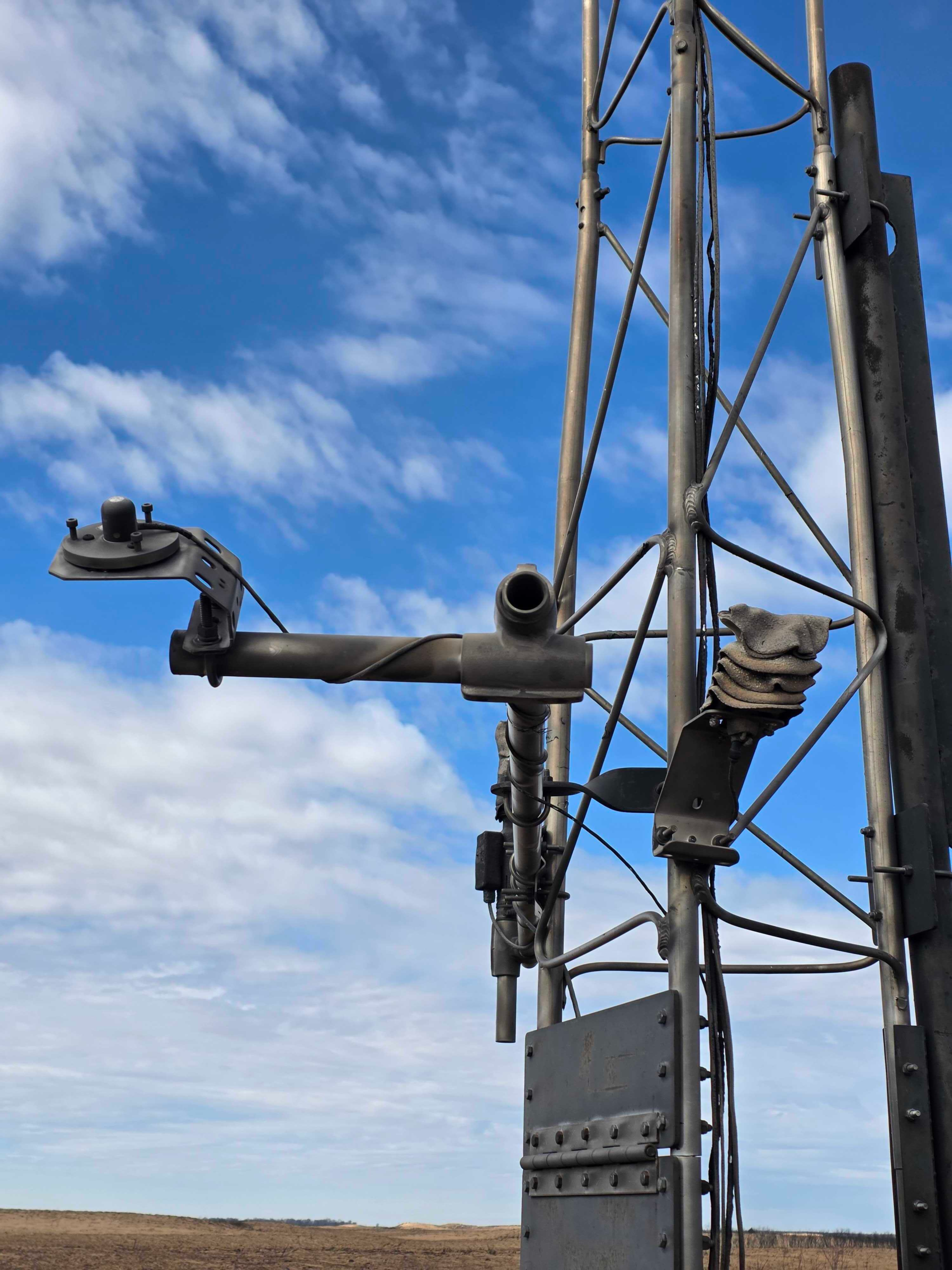
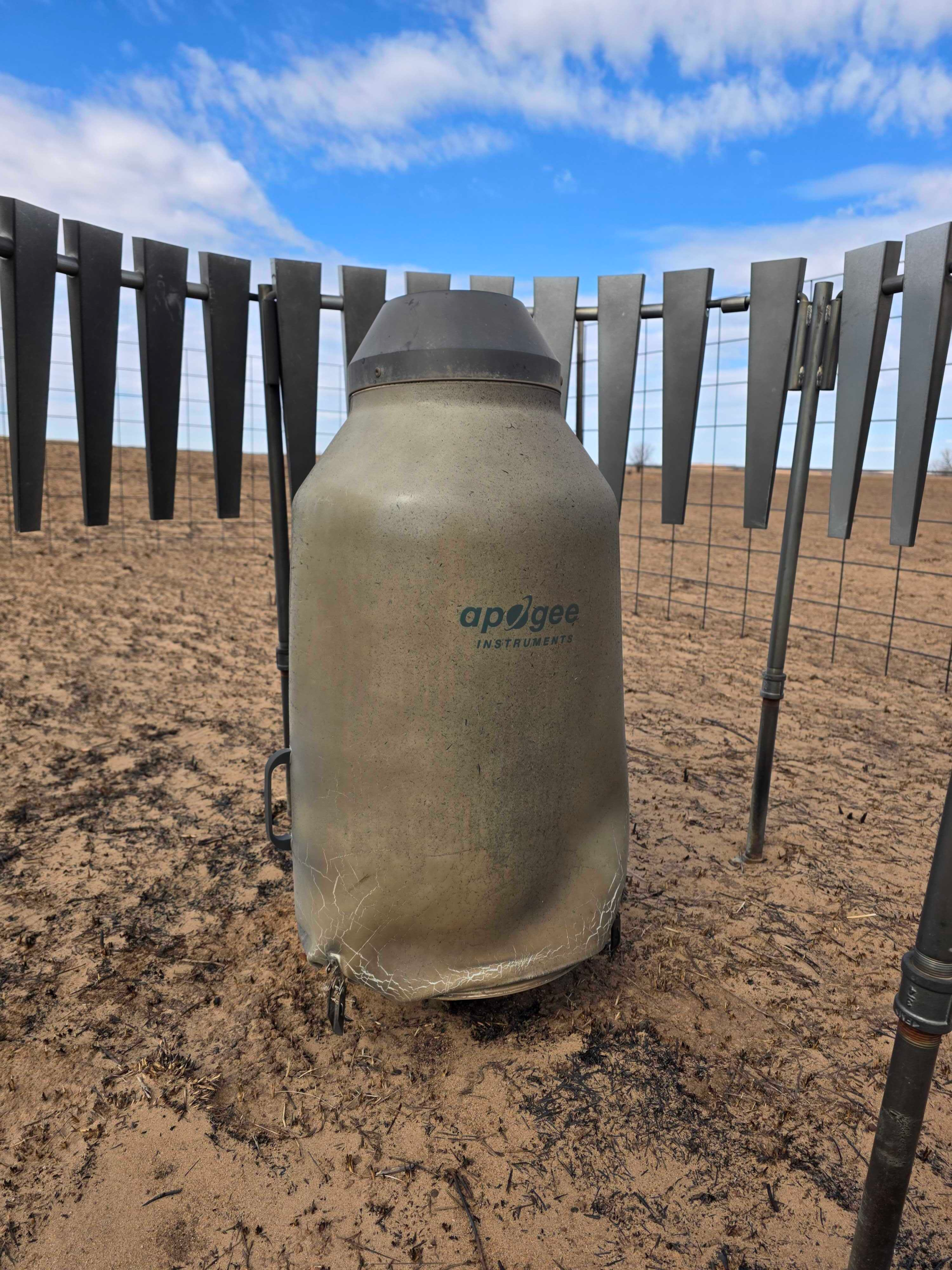
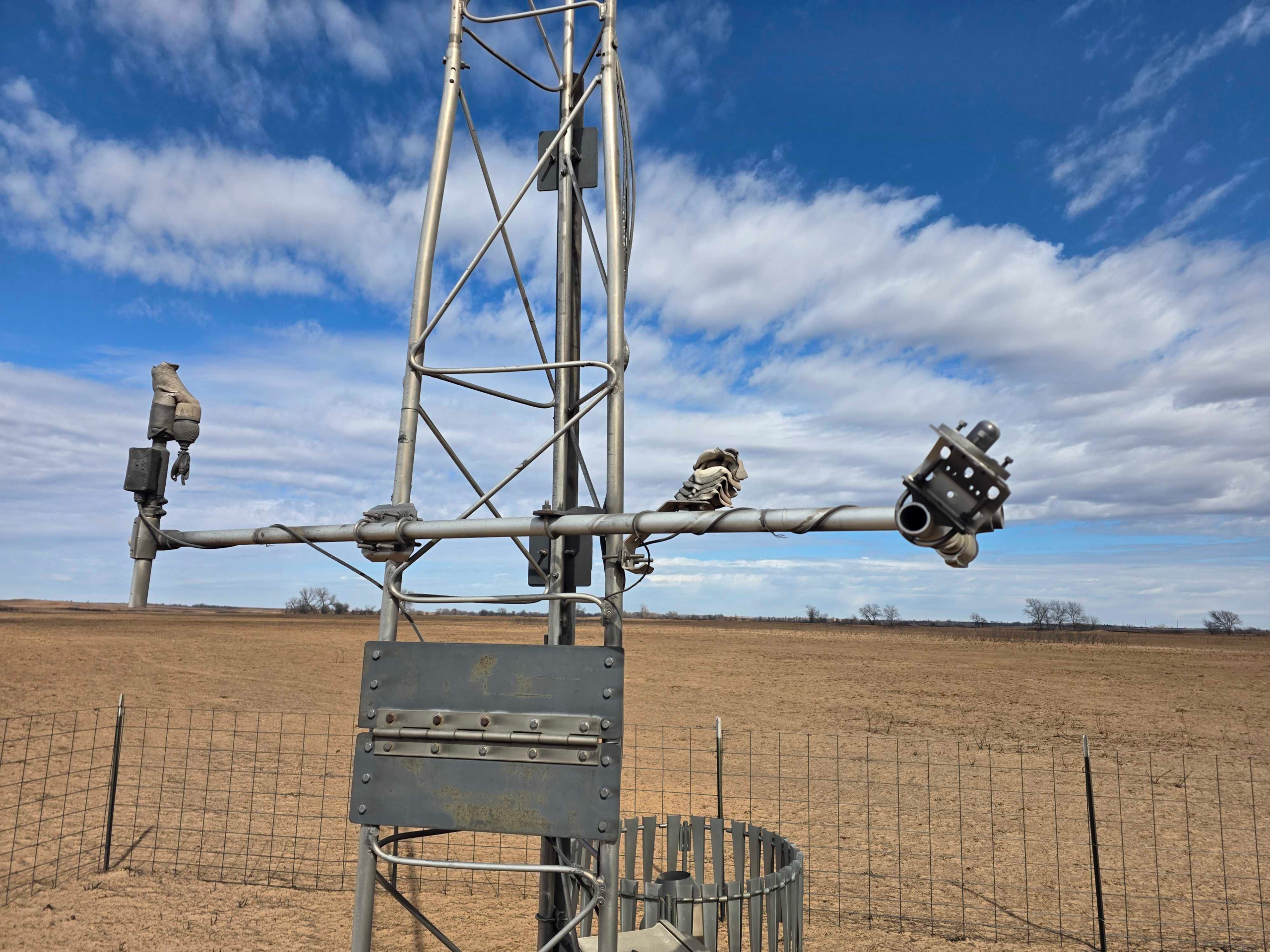
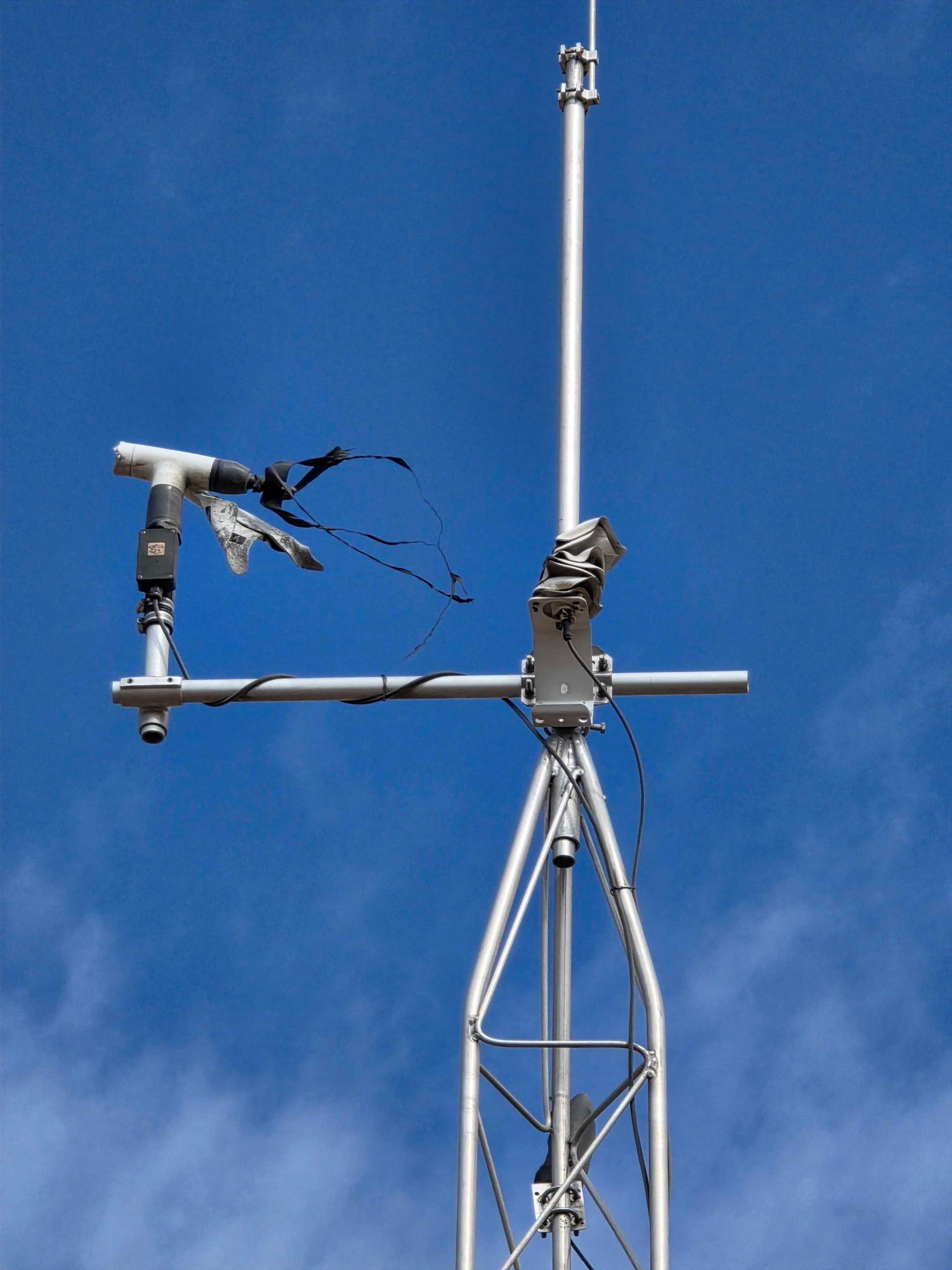
The Mesonet tower itself was still standing tall with the altershields around the rain gauges and fence around the site. The 2-meter anemometer, solar radiation shield for the temperature sensor, rain gauges, and weighing rain gauge all melted. The heat from the fire had melted the 10-meter anemometer with the propeller melting in such a way as it blew in the wind it looked as if small pieces of twine were stuck on it and blowing in the wind. The cables for the equipment were melted together with battery acid leaking. The fire did not impact the cables or equipment inside the shelter (“the Nema box”), with the datalogger and modem looking as if nothing had happened. After some time looking over the equipment, it was clear that the station would need a complete overhaul as no equipment was salvageable with the charge controller struggling to properly power the datalogger and modem. Plans were already in place the day after the fire to begin prepping and packing new equipment to quickly get the site operational again.

A week after the fire, technicians Jake Thompson and Kevin Rogosch spent a day carefully removing the damaged equipment and installed brand new instruments to get data up and running in that area once again. The first observation after the fire was made at 1 p.m. on February 24: 70°, 10-meter winds from the southwest at 8 mph, and relative humidity 13 percent.

– Jake Thompson, Technician, Kansas Mesonet

2026 Annual Meeting Update

Call for Abstracts
In case you missed it, the Call for Abstracts has been sent out.  The deadline for submission is Friday, April 17th.  To submit an abstract and present at this year’s Annual Meeting, go to https://forms.gle/ZQCrNvFUJ7wkCGRy8.

Lodging
A room block is available at the La Quinta Inn & Suites by Wyndham Fairbanks Airport (4920 Dale Rd., Fairbanks, AK, 99709) in Fairbanks.  Guests may also contact the hotel directly at 907-328-6300 and indicate they are with “AASC 2026″ to receive the group rate.  Rooms are available at the GSA rate of $254/night (plus tax) from June 21-28.

Field Excursion to Denali National Park
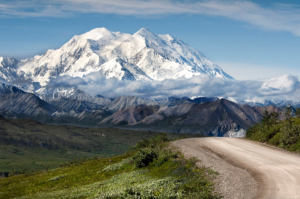
Join us for an unforgettable AASC annual meeting field excursion to Denali National Park and Preserve, where participants will explore the landscapes and climate gradients of the central Alaska Range on a one-day trip from Fairbanks. The group will have the option to travel the early portion of the Denali Park Road to Savage River (mile 15) for short hikes and informal science discussions in one of Alaska’s most iconic mountain landscapes. Along the way, attendees can choose from several activities near the park entrance, including visiting the Denali Visitor Center, exploring exhibits at the Murie Science and Learning Center, or attending a ranger talk at the famous Denali Sled Dog Kennels, home to the National Park Service’s working sled dog team. Whether you’re interested in climate science, wildlife, glacial landscapes, or simply experiencing Denali’s remarkable scenery, this trip offers a unique opportunity to combine science, exploration, and one of Alaska’s most spectacular national parks.

We will be working more details over the next couple of weeks, and are hoping to have the sign-up and payment link on the registration website. 

The general idea is to contract a bus (depending on numbers and payment on the registration site, possibly a second bus) to drive from Fairbanks to the Park and back).  Family and traveling companions of members attending the AASC meeting will be welcome to join the trip.

We will also do some sleuthing to find fun facts and point out different landmarks and changes in landscapes along the drive.

For more information, please visit the meeting website here.

Questions?  Contact Martin Stuefer (mstuefer@alaska.edu) if you have any questions about the meeting.

AASC Member Spotlight

This month’s member spotlight comes to us from the “Land of 10,000 Lakes”:  Pete Boulay of Minnesota.   
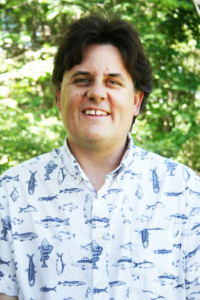
Pete Boulay

Name: Pete Boulay

Hometown: Maplewood, Minnesota

Title:  Assistant State Climatologist

Affiliation: Minnesota Department of Natural Resources (MNDNR)

Current Residence: White Bear Lake, MN

Time in Current Position: 27 years

Previous Jobs/Career:  2.5 years with Weather Eye Inc. 2.5 years with DTN (Both private weather companies) Many flight forecasts, including obscure places like Easter Island.

Research Interests: Early weather monitoring sites. Phenology. Lake Ice in/Out. UofM Campus Climate Observatory. 

Education:  B.A. Mass Communications/Television Emphasis. B.S. Metrology St. Cloud State University (SCSU), MN

Family/Pets:  Wife Nancy, Sons Ben and Charles.

Hobbies:  Stamps, history books, geographic names, records, and just about anything old.

Sports Teams I Root For:  Long-suffering fan of Minnesota Sports. 

Fun Fact(s) About Me:  I once moved Liberace’s piano in Branson, Missouri. I was a Disc Jockey at three roller skating rinks. (PJ the DJ) 

My Most Memorable Weather Event:   So many! Twin snowstorms of January 1982, Extreme Cold of December 1983, Snowfall of September 24, 1985, 73 degrees on March 7, 1987. 105 degrees on July 31, 1988. Halloween storm of 1991, Derecho (old definition) of May 15 and May 30, 1998 Thunder blizzard of April 2018 etc. etc.
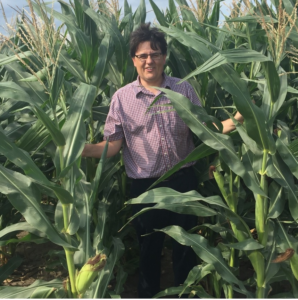
Pete Boulay in Corn Field; photo by Henry Reges

What AASC Means to Me:  Sometimes the winds of budgetary and political change put the nation’s climate heritage in danger. The folks that make up the AASC are the guardians of weather archives for their state. Many offices are the public point of contact for climate services and partner with their local National Weather Service Offices, Regional Climate Centers and NCEI. People who make up the AASC may come from all corners of the country, but all have one thing in common, they share the excitement of watching the weather.
Committee Updates

ARSCO Committee

The ARSCO committee met on March 16 and set due dates of April 15 for ARSCO 5-year renewal packets and April 30 for 2025 annual reports from all ARSCO states and any other state that would like to send one in. We hope to have the reports compiled before the annual meeting in Fairbanks in June.

Communications Committee

WANTED:  Guest Writers!

If you’re interested in submitting a short story/article for the newsletter, please reach out to us at communications@stateclimate.org.  This month, we have a brief write-up about a fire that burned a mesonet station in Kansas (We hear they like their weather stations crispy in Kansas!  Too soon?).  This is a great way to share something about your office or network that isn’t quite newsworthy enough to get into a press release or land on a webpage somewhere. 

Member News

  • (Georgia)  The UGA Weather Network is now fully staffed with the addition of a second full-time technician, Talon Tarleton. The team is also preparing for an upcoming leadership transition, with Pam Knox retiring on June 1 and a search for her replacement launching soon. Additional information will be shared as it becomes available, and questions can be directed to Pam at pnknox@yahoo.com.

  • (New York/Northeast Regional Climate Center)  At the Northeast Regional Climate Center, New York State Climatologist Keith Eggleston recently highlighted new hourly ACIS tools during the Center’s February webinar. He also developed code to maintain access to USGS WaterWatch data for stakeholders, now available through the Northeast DEWS Dashboard.

  • (South Carolina) The South Carolina State Climatology Office received two Notable State Document Awards from the South Carolina State Library for the following publications: A Tale of Two Storms: Debby and Helene is an ArcGIS StoryMap that highlights the widespread impacts of Tropical Storm Debby and Hurricane Helene on South Carolina during the 2024 Atlantic Hurricane Season. The South Carolina Year in Review 2024 provides an in-depth overview of precipitation and temperature patterns, as well as significant weather events to impact South Carolina throughout 2024.

  • (Washington) The UW Climate Impacts Group (parent organization of Washington State Climate Office) just had a very successful film screening for The White House Effect, a new documentary that uses all vintage footage to tell the story of climate change action in the George HW Bush administration. The directors attended the screening, along with a panel of climate experts. The event was attended by 100-200 people, many of whom are current or past collaborators and supporters.

  • (Wisconsin) The Wisconsin State Climatology Office and the Wisconsin Environmental Mesonet (Wisconet) co-hosted a statewide Climate Services Summit on March 17 and 18, 2026, in Madison, Wisconsin. The purpose of the Summit was to bring together providers and users of weather and climate information to increase awareness of existing services, strengthen coordination across sectors, and identify unmet needs.

Have a story you’d like to share about your organization?  Please submit your idea to us here.

Trivia!

Who doesn’t enjoy weather and climate trivia?  Certainly not the AASC!  Lets see if you can solve this month’s trivia questions from the AASC Newsletter’s Trivia Master, Matt Sittel:

  1.  How many states had at least one climate division that recorded its warmest meteorological winter (DJF) on record in 2025-26, based on NCEI’s monthly data that were released on March 9?
    1. 9 states
    2. 11 states
    3. 13 states
    4. 15 states

2.  Two adjacent states shared honors for averaging the most above normal in February 2026 (when compared to the 1901-2000 normals that appear on NCEI’s “Climate at a Glance” page). Which two states pulled off this double superlative?

    1. Montana and Wyoming
    2. Kansas and Oklahoma
    3. North Dakota and South Dakota
    4. Minnesota and Iowa

3.  This year’s AASC meeting site, Fairbanks, Alaska, picked up 74.2” of snowfall this past meteorological winter. How does this total compare to Fairbanks’ winter normal?

    1. More than 40 inches above normal
    2. Around 20 inches above normal
    3. Within 10 inches of normal
    4. More than 20 inches below normal

4. Laredo, TX tied its February record high on the 26th by reaching _____ degrees. (Hint: it was 27° above the normal for the date.)

5. The highest CoCoRaHS precipitation total for the month of February 2026 was near Paauilo on the big island of Hawaii. To the nearest five inches, how much rain fell?

See answers to this month’s trivia questions at the bottom of the newsletter!

Photo of the Month

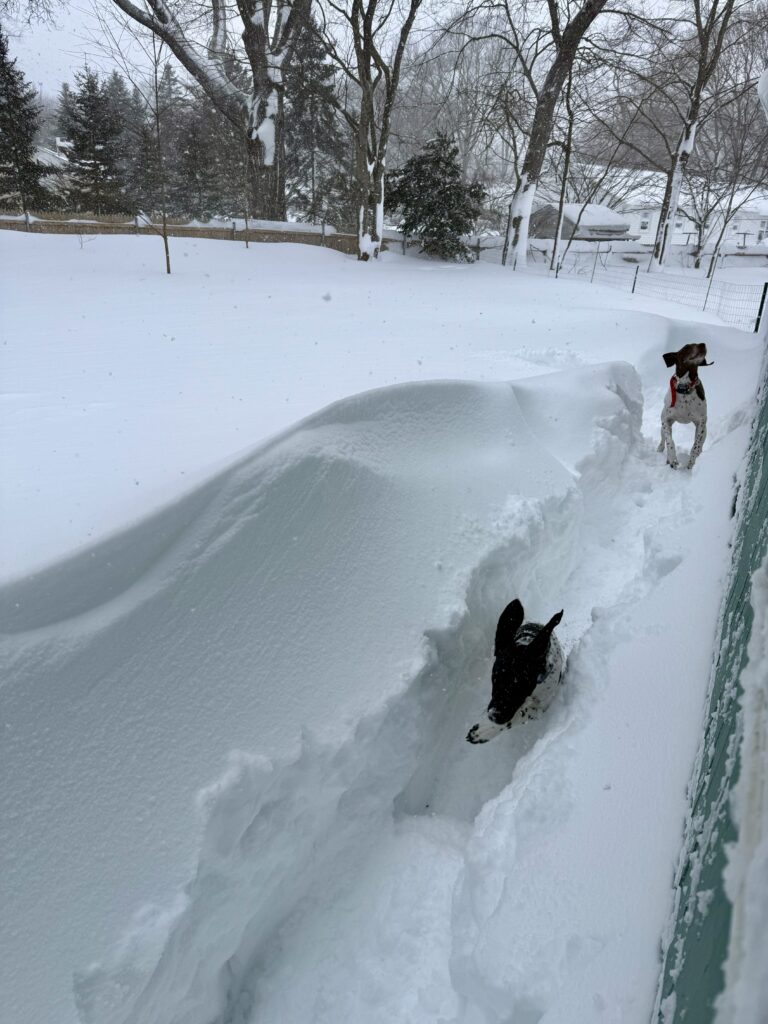
The February 22-23, 2026 blizzard most likely set a new state record for 24-hour snowfall in Rhode Island after 37.9″ of snow was recorded at R.I. T.F. Green Int’l Airport (note: ongoing review by the SCEC). This photo, taken by Rhode Island State Climatologist Joe Poccia in East Greenwich (5.5 miles south of TF Green Airport), shows his two dogs running next to a 5′ high snow drift.

Contact the AASC

Have a suggestion for the newsletter?  Then contact the AASC Communications Committee at communications@stateclimate.org.  

For general inquiries about the AASC, contact the AASC Secretary at secretary@stateclimate.org.

Visit the AASC on the web at https://stateclimate.org!

Trivia Question Answers: 1) D. 15 States | 2) C. Both averaged +12.3 degrees F in February. | 3)  The normal is only 31.1 inches | 4)  103 degrees F | 5) 35 inches;  their total was an impressive 35.55 inches in February.